Lighting the bedroom and dressing room: Lighting plan for bed, wardrobe and mirror

A bedroom is rarely used only for sleeping. In the morning you choose clothes, in the evening you read in bed, and in between you stand in front of the mirror or put laundry away in the wardrobe. Each of these activities has different lighting requirements. A single ceiling light in the center of the room does not really meet any of them: in front of the wardrobe you stand in your own shadow, and in bed it is too bright and too cool for the evening.
Plan four separate lighting zones – general lighting, lighting at the bed, lighting on the wardrobe front, and lighting at the mirror. Switch or control the sleeping area independently from the dressing area. Warm and dimmed in the evening, brighter, even, and with good color rendering when getting dressed. Add a dim orientation light for the night if needed.
First the floor plan, then the light
Before you think about light models, a simple sketch is worth it: bed, wardrobe, mirror, doors, and windows. Mark where you stand when getting dressed, which direction the wardrobe doors swing open, and where the existing ceiling outlet is located. These ten minutes save most wrong purchases later.
This also clarifies what type of room it actually is:
- Wardrobe on one wall of the bedroom: The sleeping and dressing areas share a room and often also a ceiling connection.
- Dressing alcove: A defined area, often without its own window and with little space in front of the compartments.
- Separate dressing room or walk-in wardrobe: There is no sleeping area here, so artificial light often has to do all the work.
The lighting zones at a glance
General lighting
General lighting is used for orientation, tidying up, and making the bed. It does not have to be particularly bright, but it should be dimmable. In the bedroom, it is rarely the main lighting, but rather the basis on which the other zones are built.
Lighting at the bed
For reading, you need focused light on the book, not on the face. Wall or pendant lights next to the bed should be positioned so that the light source is not directly in the field of vision from a lying position. If someone is sleeping next to you, a tightly focused reading light is more considerate than a bright ceiling light.
Lighting on the wardrobe front
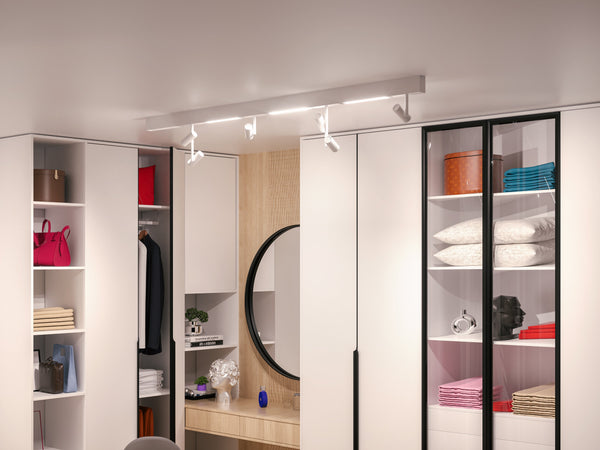
Here, position is especially important. If the light is too far behind you, your own body will cast a shadow exactly on the surfaces you are looking at. Better is light from above, as close as possible in front of the wardrobe front, falling diagonally on the doors and compartments. As a rough guide, a distance of around 90 to 120 centimeters between the light and the wardrobe front has proven effective – more for high ceilings, less for low wardrobes with open compartments. Check whether open wardrobe doors block the light.
Lighting at the mirror
You should be seen in the mirror, not the mirror. The light must therefore reach you, from the front or from the side. On a full-length mirror, a light above and slightly in front of your standing position, directed diagonally at you, works well. For the face and makeup, light on both sides at about eye level is the most even. Light exclusively from above creates shadows under the eyes and chin, light only from behind makes you appear dark in the mirror. Also make sure that the light does not reflect in the mirror from your line of sight.
Accent and orientation lighting
Indirect light behind the headboard or on a shelf creates atmosphere, but does not replace functional light. For the nightly path to the door or bathroom, a very dim, warm light near the floor is sufficient, ideally with a motion sensor. It should show the way, not brighten the room.
Light color, brightness, and color rendering – what the values mean
Color temperature in Kelvin
Color temperature describes how warm or cool white light appears. This classification is common: Warm white below 3,300 K, neutral white from 3,300 to 5,300 K, daylight white above that. Warm white feels cozy and calm, neutral white objective, daylight white clear and cool. Our guide to color temperature explains the gradations and examples.
For the evening in the bedroom, there are many arguments for warm light. The Federal Office for Radiation Protection points out that light with a low color temperature has a lower blue content and is therefore suitable for rooms used in the evening. However, the Kelvin number alone does not fully describe the effect – brightness and duration also play a role. A sleep promise cannot be derived from this, but a reasonable basic rule can: warmer and darker in the evening than in the morning.
Lumens and lux
Lumens indicate how much light a light fixture emits in total. Lux describes how much of it reaches a surface – for example, the clothes in the wardrobe compartment. For planning, lux is the more meaningful measure, because the same light fixture produces very different brightness levels depending on the distance, beam angle, and orientation.
There are no binding standard values for living spaces. However, orientation values have become established in planning practice: For general lighting in the bedroom, 100 to 200 lux are usually sufficient, 300 to 500 lux are comfortable at the wardrobe front and mirror if colors are to be assessed. Understand these numbers as a guideline, not a rule. Anyone who can dim will find the right value in their own room anyway.
Color rendering (CRI or Ra)
The color rendering index describes how natural colors appear under a light source compared to a reference. The maximum value is 100. With simple LED bulbs with values around 80, colors often look somewhat dull, and dark blue and black fabrics are difficult to distinguish. For the dressing area, a CRI of at least 90 makes sense. Anyone who wears a lot of red can also pay attention to the R9 value in the data sheet, which specifically indicates the rendering of saturated red tones.
NOVARAIL LED modules achieve CRI 97. But a high value does not replace a good position: even a red dress remains difficult to assess in the shadow. More on this in the guide to the color rendering index.
Glare
Visible LED dots shining directly into the eye are especially distracting when lying down and at the mirror. Pay attention to adjustable spotlights, diffusers, or lights whose light output is not directly visible from the usual line of sight.
Lighting by time of day: five scenes
One room, two tasks – the conflict between a relaxed evening atmosphere and precise color assessment can be solved most easily through scenes. The following settings are default values that you can adjust in your own room:
| Scene | Active zones | Light color | Brightness |
|---|---|---|---|
| Morning | General lighting, wardrobe | neutral, about 4,000 K | medium to bright |
| Dressing | Wardrobe, mirror | neutral, about 4,000 to 5,000 K | bright |
| Reading | Reading light at the bed | warm, about 3,000 K | focused, room dimmed |
| Evening | General lighting, accent | warm, 2,700 K | dimmed |
| Night | Orientation light | very warm | very dim, near the floor |
Why not the coolest light when getting dressed? Daylight white beyond 5,500 K quickly looks cold in interiors at moderate brightness and makes skin tones appear pale. Neutral white is closer to the light in which you actually wear your clothes during the day. Anyone who is still picking out something for the next day in the evening switches briefly to the dressing scene and then back.
Three typical floor plans
1. Bedroom with wardrobe on one wall
Positions: A ceiling light or track system parallel to the wardrobe front, with adjustable spotlights on the doors and compartments. Reading light on both sides of the bed. An accent light as desired.
Control: At least two groups – wardrobe separate from the sleeping area. With smart control, one connection is sufficient if the lights can be switched individually or in groups.
Typical mistake: The ceiling light is positioned in the center above the bed. You then stand in front of the wardrobe with your back to the light.
2. Small dressing alcove in the bedroom
Positions: Light directly above the area in front of the alcove, directed at the compartments. A mirror on the side wall or door with light from the front or side.
Control: Own switching group, so that the alcove can be bright while the sleeping area remains dark.
Typical mistake: Indirect LED strips as the only lighting. They look good, but do not bring enough light into the compartments.
3. Separate dressing room without a window
Positions: For a row of wardrobes, a track or row of spotlights parallel in front; for wardrobes on two opposite sides, light on both sides or in the center with spotlights in both directions. Additionally, mirror light and, for deep compartments, interior lighting.
Control: Motion sensors or door contacts are practical here because you usually enter the room with full hands.
Typical mistake: Too warm light as the only light. Without daylight for comparison, color differences are only noticeable outside.
Choosing lights: what fits where
- General lighting: Ceiling light, recessed spotlight, or a track system. Tracks have the advantage that the light points can be moved later if furniture is rearranged.
- Wardrobe front: Adjustable spotlights on the ceiling or on a track in front of the wardrobe.
- Inside the wardrobe: LED strips under shelf bottoms or on the clothes rail, preferably in an aluminum profile with a diffuser, so that no individual light points are visible. For wardrobes without an outlet, there are battery-powered strips with motion or door sensors.
- Mirror: Side wall lights, mirrors with integrated lighting, or a spotlight above the standing position.
- Bed: Wall lights with a swiveling head or pendant lights that can be adjusted in height.
Control and retrofitting
The best lighting concept is of little use if everything is on one switch. Separate circuits for the sleeping and dressing areas are ideal, but often not available in existing buildings. Then smart lights help: they hang from one connection, but can be dimmed individually or in groups and changed in color temperature. Scenes like "Dressing", "Reading", or "Evening" are thus just a fingertip away.
In rental apartments, the existing ceiling outlet is usually the only fixed connection. A track system that supplies several zones from this point avoids new wiring. For wardrobe interiors and orientation light, battery-powered lights with a sensor are suitable.
For safety: Work on the 230-V network belongs in the hands of a qualified electrician. Install power supplies and transformers according to the manufacturer's specifications and do not hide them in enclosed cavities without air circulation. LED strips in the wardrobe should be in profiles and not lie directly on textiles.
Common mistakes
- Only one bright ceiling light for all tasks.
- The light in front of the wardrobe is behind the standing position instead of in front of it.
- The mirror is illuminated exclusively from above or from behind.
- Warm, dimmed light is the only light in the dressing area.
- Visible LED dots blind when lying down or reflect in the mirror.
- Different light colors are mixed unintentionally, for example, a cool wardrobe light next to a warm bedside light.
- Indirect accent light is confused with functional wardrobe light.
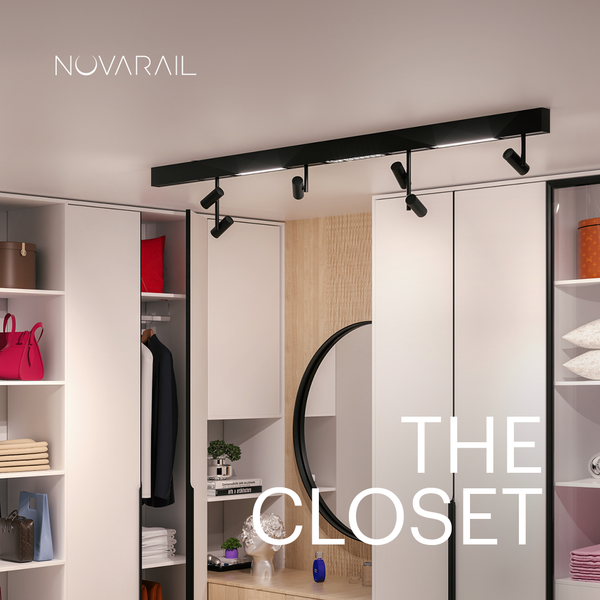
THE Closet as a starting point
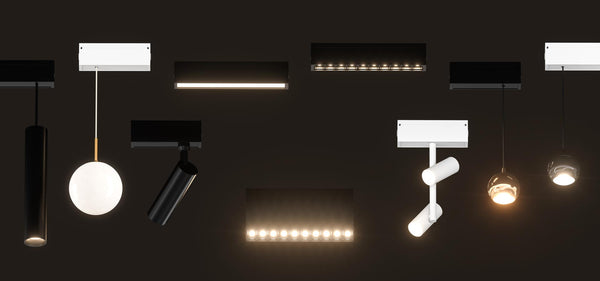
THE Closet is the preconfigured NOVARAIL set for dressing rooms and walk-in wardrobes. The set is available with a track length of 1.5 or 2 meters, in black or white. The track is screwed to the ceiling and connected to the existing ceiling outlet; with an additional pendant set, it can also be mounted suspended. You can move the magnetic lights along the track and align them to individual wardrobe sections.
All lights have CRI 97 and a light color of 2,700 to 6,500 K. You can switch them on and off as usual via the light switch. You control dimming, light color, groups, and scenes via the app; for this, the compatible gateway is required. Each element can be addressed individually, so that wardrobe and mirror lighting can be adjusted independently of each other.
A separate bedroom complete set is not currently available. If the bed, wardrobe, and mirror are in one room, plan the zones together and compare the track length and lights with your floor plan. In the Bedroom & Dressing Room category, you will find the set, for other room shapes, the 3D configurator helps.
Frequently asked questions
Which light color is suitable for bedrooms and dressing rooms?
In the sleeping area, warm white around 2,700 to 3,000 K, especially in the evening. For dressing, neutral white around 4,000 K is suitable, because colors appear closer to daylight in it. If both areas are in one room, adjustable light is the simplest solution.
Is a ceiling lamp sufficient in the bedroom?
For orientation, yes, for reading and dressing, usually not. A centrally positioned light creates shadows in front of the wardrobe and is too bright at the bed. At least one additional light for the wardrobe or bed is sensible.
How do I illuminate a mirror without shadows?
The light should reach you from the front or from both sides, for the face at about eye level. Avoid light only from above or only from behind.
How do I illuminate a wardrobe without an outlet?
With battery-powered LED strips or lights with a motion or door sensor inside. From the outside, ceiling spotlights in front of the wardrobe front shine into open compartments, without electricity having to be in the wardrobe.
Are LED strips in the wardrobe sufficient?
For the wardrobe interior, often yes, as the only lighting of the dressing area, usually not. They illuminate compartments and rails, but not you in front of the wardrobe or at the mirror.
Which color rendering index is sensible for clothes?
At least CRI 90. Higher values make the difference between similar tones like dark blue and black clearer. For red tones, the R9 value additionally provides information.
How do I illuminate a dressing room without a window?
Evenly and sufficiently bright on the wardrobe front and mirror, with neutral white light and high color rendering. Check dark corners on shelves and supplement deep compartments with interior lighting.
Should I switch bedroom and dressing lights separately?
Yes. Only this way can the dressing area be bright while the sleeping area remains dark – for example, when one person gets up earlier. Without a second circuit, this is achieved with individually controllable smart lights.
Does NOVARAIL have its own bedroom set?
Currently, it is available in the joint category THE Closet for dressing rooms and wardrobes. For further zones of the bedroom, you can plan an individual solution in the 3D configurator. A separate set for the bedroom will follow shortly.