
Color Rendering Index (CRI / Ra): What does the CRI value mean for LEDs?

In short: The colour rendering index describes how natural colours appear under an artificial light source. Internationally, the CRI (Colour Rendering Index) is most commonly used, while Ra is frequently used in German-speaking countries. Generally, a higher value means better colour rendering. For high-quality residential and work areas, values from CRI/Ra 90 are particularly appealing.
What is the CRI value?
The CRI value assesses how well a light source renders selected colours compared to a defined reference light source. The scale usually goes up to 100. A value close to 100 means that the tested colours appear very similar under the light source as they do under the reference light source.
Important: CRI 100 does not automatically mean that a lamp is identical to sunlight in every respect. The value describes exclusively the colour rendering based on defined test colours.
CRI, Ra and colour rendering index – are they the same?
In everyday use, CRI, Ra and colour rendering index are often used synonymously. However, there is a small technical distinction:
- CRI is the international designation for the Colour Rendering Index.
- Ra refers to the general colour rendering index.
- Ra is calculated from the test colours R1 to R8.
This is why you will find specifications such as CRI 90, Ra 90 or CRI > 90 on data sheets. In practice, these specifications usually describe the same basic property: the quality of colour rendering.
CRI table: How good are 80, 90, 95 or 97?
| CRI / Ra | Classification | Typical application |
|---|---|---|
| below 80 | basic colour rendering | areas where colour fidelity is hardly relevant |
| 80–89 | good standard colour rendering | general lighting |
| 90–94 | very good colour rendering | living rooms, kitchen, office, high-quality interiors |
| 95–100 | very high colour rendering | design, retail, photography, high-quality residential and work areas |
The table serves as a practical guide. For special applications, individual R values or other colour rendering metrics may also be relevant.
What does CRI 90 mean?
CRI 90 stands for very good colour rendering. Colours generally appear significantly more natural and nuanced than under a typical standard LED with CRI 80.
The difference can be particularly visible with wood, textiles, food, skin tones or coloured surfaces.
What does CRI 95 or CRI 97 mean?
CRI 95 or CRI 97 stands for even higher colour rendering. Such values are particularly appealing when materials and colours are to appear as authentic as possible.
NOVARAIL uses luminaires with CRI 97 in many lighting systems. The values achieved by a specific luminaire module should always be checked on the respective product page.
Why is R9 important?
The general Ra value is based on the test colours R1 to R8. Saturated red is not taken into account. For this, there is the separate value R9.
R9 can be important, for example, with:
- food and gastronomy
- skin tones
- red textiles and materials
- art and photography
- medical or cosmetic applications
A high general CRI is therefore an important quality criterion, but not always a complete description of colour rendering.
Why is a high CRI useful in the kitchen?
In the kitchen, food, fronts, worktops and materials should look as natural as possible. A high colour rendering index can help to perceive subtle colour differences more clearly.
For high-quality kitchen lighting, in addition to CRI, light distribution, brightness, glare and the appropriate colour temperature should also be considered.
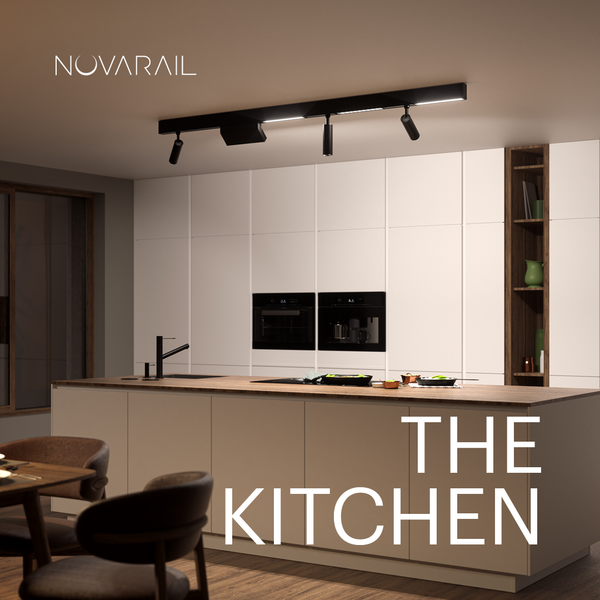
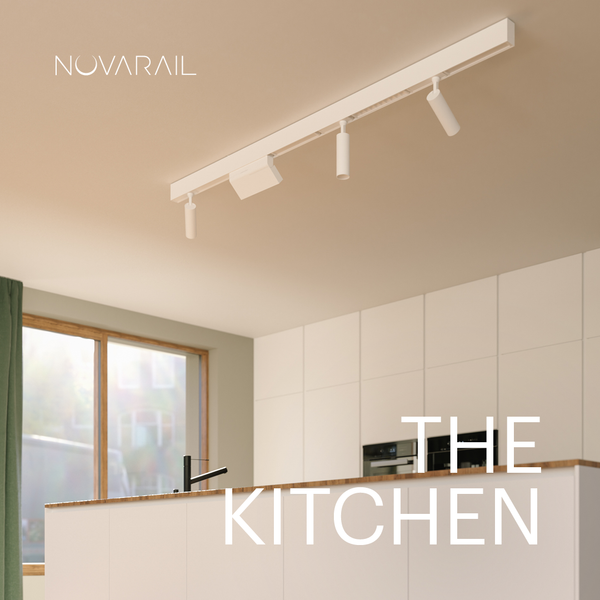
THE Kitchen – NOVARAIL track system for the kitchen
THE Kitchen X – kitchen island lighting with pendant lights
Why is CRI relevant at the dining table?
At the dining table, light influences not only the atmosphere, but also the perception of food, tableware, wood and other materials. High colour rendering ensures that these colours appear more natural.
THE Dinner – lighting system with pendant lights for the dining table
Why is CRI important in the dressing room?
With clothing, good colour rendering is particularly helpful because similar shades such as dark blue, black, brown or grey can be harder to distinguish under weak or colour-distorting light.
THE Closet – lighting for dressing rooms and wardrobes
CRI and Kelvin: What is the difference?
CRI and Kelvin measure two completely different properties.
- CRI / Ra: How faithfully are colours rendered?
- Kelvin: How warm or cool does the white light appear?
A luminaire can, for example, have 2,700 K or 4,000 K and still have a CRI of 90 or 97 respectively.
Colour temperature in Kelvin simply explained
Does a higher CRI automatically mean better light?
Not on its own. A high CRI is an important quality criterion, but good light also depends on several other factors:
- Light quantity and illuminance
- Colour temperature
- Glare
- Light distribution and beam angle
- Position of the luminaires
- Flicker behaviour
A high-quality lighting concept considers these factors together.
Combine CRI in the 3D configurator with lighting planning
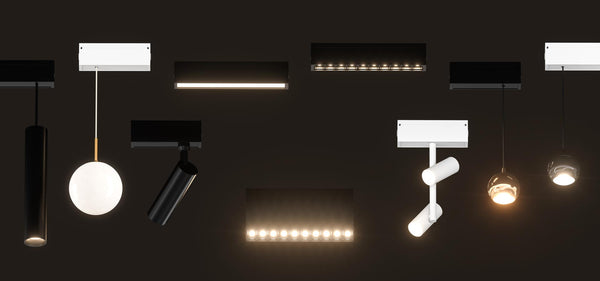
When planning a lighting system, it is not just about using as many luminaires as possible. What matters is which light is needed where. Basic lighting, accent lighting and pendant lighting can be combined within a modular track system.
Plan NOVARAIL in the 3D configurator
Frequently asked questions about the CRI value
What is a good CRI value for LEDs?
For general applications, CRI 80 is common. For high-quality residential, work and presentation areas, CRI 90 or higher is usually the better choice.
Is CRI 90 good?
Yes. CRI 90 is considered very good colour rendering and is significantly above many standard LEDs with CRI 80.
Is CRI 97 better than CRI 90?
A CRI of 97 shows a higher agreement with the reference light source in the general colour rendering index than CRI 90. How clearly the difference is visible depends on the application, spectrum, materials and individual colour shades.
What does Ra 80 mean?
Ra 80 means that the general colour rendering index is 80. This is a common value for many standard light sources and is often sufficient for basic general lighting.
What does Ra 90 mean?
Ra 90 describes very good general colour rendering. Materials and colours generally appear more natural than with Ra 80.
Is Ra the same as CRI?
In everyday language, both terms are usually used synonymously. More precisely, Ra refers to the average of the test colours R1 to R8 within the CRI method.
Why can a lamp with a high CRI still render red poorly?
Because the general Ra value does not include R9 – saturated red – in its average. For applications where red is particularly important, R9 should therefore also be considered.
Does colour temperature affect CRI?
Colour temperature and CRI are different values. A luminaire can have a high or low colour rendering at different Kelvin values.
Further reading: Understanding the 48-V LED track system
How the track, transformer, spotlights, pendant and room luminaires work together at NOVARAIL is explained in our central system guide: 48-V LED track system – construction, advantages and applications.
Conclusion
The colour rendering index is a key value for the quality of LED light. As a simple guide: CRI 80 is standard, CRI 90 is very good and CRI 95 or higher is particularly suitable for demanding applications.
However, CRI should never be considered in isolation for sound lighting planning. Colour temperature, brightness, glare, light distribution and individual colour rendering values such as R9 are also part of the overall quality of lighting.