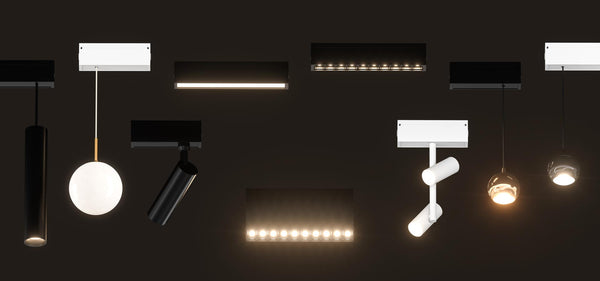
The key to perfect lighting design: A guide for your home

Light is far more than mere brightness – it is a design element that shapes spaces and surfaces, creates moods, and significantly influences our daily well-being. Whether at home, in the office, or in prestigious commercial spaces: lighting and lighting technology are far more than technical details. Lighting structures spaces, influences our perception, and creates atmosphere. But it is only with thoughtful lighting advice and lighting design that room lighting reaches its full potential – functional, emotional, and architectural.
Professional lighting design helps to use light sources strategically: adapted to the architecture, use, time of day, and design concept. Advice and planning for LED lighting take into account not only the right brightness in interiors, but also aspects such as light sources, lighting calculations, light quantity, light distribution, color temperature, color rendering (CRI), glare-free operation, and control convenience. The result is room lighting that not only looks good – but also feels good.
Whether new construction, renovation, commercial projects, or an individual lighting concept: sound lighting planning and the targeted use of high-quality LED lighting are the keys to an environment that inspires, supports, and makes an impression. In this guide, you will find tips, ideas, and answers to frequently asked questions about lighting planning – from technical basics to aesthetic impact. We will show you what matters when choosing suitable luminaires, what costs are realistic, and when support from a lighting designer makes sense. Discover how you can implement smart, holistic lighting design with NOVARAIL luminaires – for spaces that not only appear illuminated, but also come alive. If you need help with planning: we are here for you.
Lighting with a System – The Layered Principle of Lighting Designers
Successful lighting begins with a clear concept. The foundation is general lighting, which provides uniform basic brightness and makes it easier to orient yourself in the space. It is complemented by task lighting, which brings targeted functional light where it is needed – for example, on kitchen work surfaces or at a desk. Finally, the design framework is formed by accent lighting, which creates atmosphere, sets focal points, and highlights architectural details. Only the interplay of these three types of lighting gives a room structure, depth, and balanced light quality.
General Lighting: The Functional Foundation
General lighting forms the basic framework of any lighting plan. It provides uniform brightness, makes orientation easier, and ensures that everyday activities can be carried out reliably – whether it is tidying up, cooking, eating, or simple routines. Without functional basic lighting, every room remains incomplete – it not only creates visibility, but also conveys a fundamental sense of openness, structure, and orientation, which can be realized through targeted planning in two proven approaches:
-
Diffusely Scattered Light
Light is distributed evenly in all directions through frosted glass, milky covers, or fabric shades. The result: a soft, glare-free lighting effect without harsh shadows, ideal for centrally placed ceiling lights, light panels, or pendant lights with a diffuse appearance. -
Indirect Light
Instead of shining directly into the room, the light is directed onto walls or ceilings and gently reflected from there. This creates a calm, harmonious lighting mood that makes spaces appear visually larger and more structured – particularly suitable for living, sleeping, or entrance areas.
Depending on the room size, ceiling height, and desired lighting mood, general lighting can be realized as a surface ceiling solution (e.g., LED panels) or as a linear light strip in the ceiling system. Modular systems such as the NOVARAIL track system are particularly flexible, allowing individual adjustment of intensity and color temperature – efficient, discreet, and versatile.
A high-quality general lighting system is therefore not only functional, but also the aesthetic starting point for any lighting concept – the foundation on which zone, accent, and mood lighting can be strategically built.
Zone Lighting: Task and Secondary Lighting
While general lighting structures the room as a whole, zone lighting – also called secondary or functional lighting – focuses on clearly defined areas within the room. It brings light to where targeted brightness is needed: for precise work, safe movement, or concentrated reading.
In contrast to basic lighting, zone lighting is more directional, often brighter, and tailored to specific visual tasks. Here, not only positioning plays a role, but also glare-free operation and light quality (e.g., a high CRI value).
Typical applications for zone lighting include:
-
Kitchen Work Surfaces
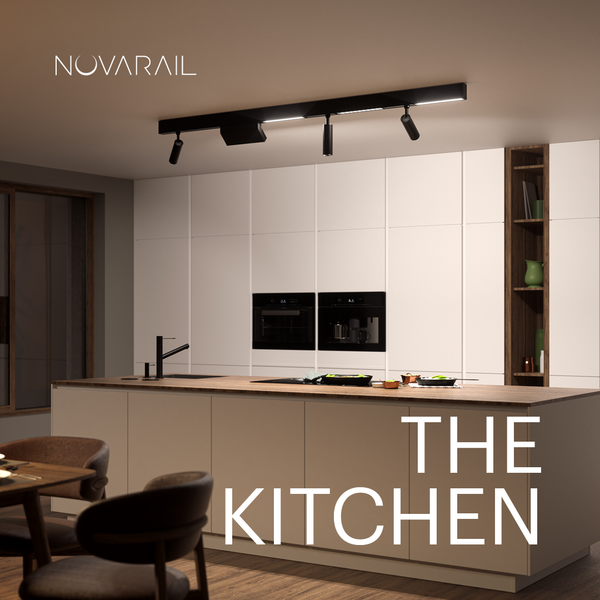
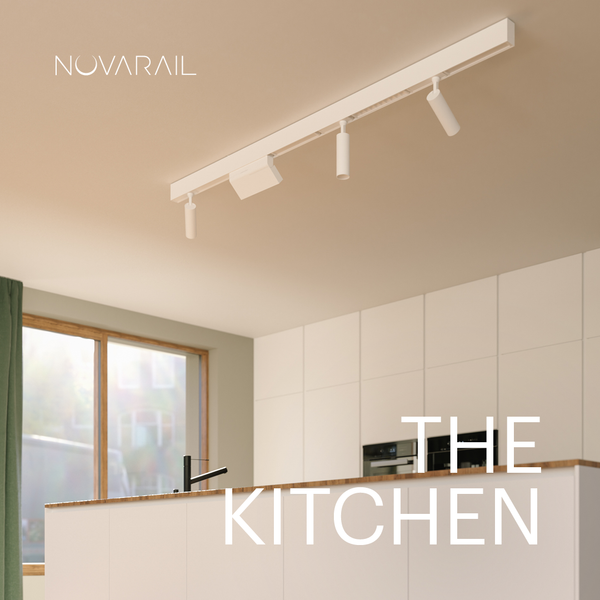
Here, a shadow-free, powerful illumination of the countertop is essential. Under-cabinet lights or spotlight modules with neutral-white to cool-white color temperatures (approx. 4,000 to 5,000 K) ensure precise cutting, cooking, or cleaning. -
Bathroom Mirror Areas or Dressing Tables
To illuminate facial areas evenly, side-mounted luminaires with a high color rendering index (CRI > 90) are ideal. This prevents color distortion – crucial for makeup, skincare, or shaving. -
Living Room Reading Nooks
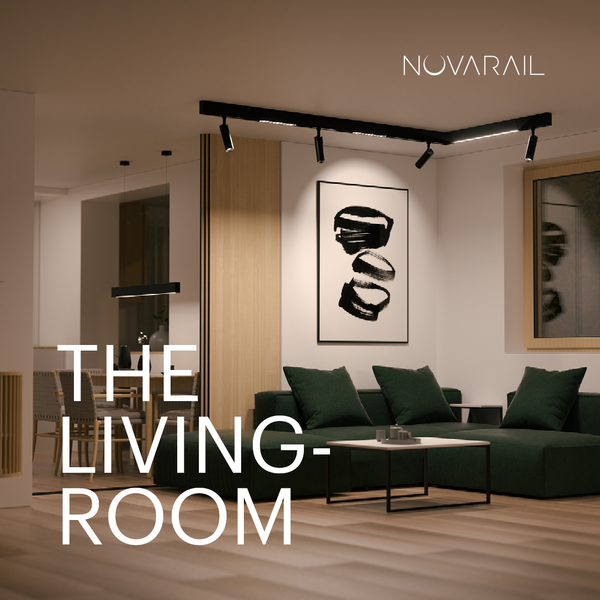
A well-positioned floor lamp or an adjustable spotlight with warm-white light (approx. 2,700 to 3,000 K) creates comfortable reading light, without disturbing the rest of the room. -
Home Office Desk
Whether through a glare-free desk lamp or ceiling-mounted spotlight modules: daylight-like light is required here, which promotes concentration and prevents fatigue. Color temperatures between 4,000 and 6,000 K are recommended – ideally adjustable via an app or dimming function.
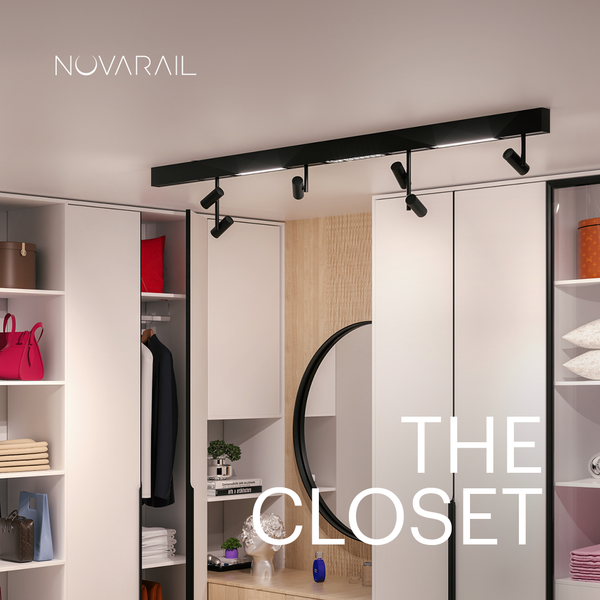
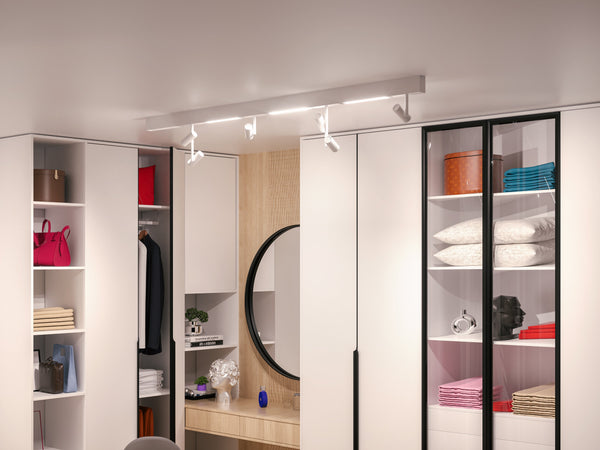
Thoughtful zone lighting not only supports the respective activity, but also contributes significantly to the ergonomics and functionality of a room. With modular lighting systems such as NOVARAIL, these areas can be implemented in a targeted, flexible, and aesthetically sophisticated manner – whether through magnetically integrated spotlights, adjustable track modules, or segment-controllable lighting scenes.
Zone lighting is therefore not just a supplement, but a central building block of functional lighting design, which divides rooms into usage zones without visually partitioning them.
Accent Lighting: Creating Atmosphere
While basic and zone lighting provide function and structure, the third layer brings life into the room – emotional, individual, and atmospheric. It sets targeted lighting accents, directs the gaze, highlights materials, or simply creates mood and depth. In this regard, it fulfills less of a practical than an emotional function – it makes spaces experiential.
A Perfect Sense of Light Through Targeted Planning – with Color Temperature and CRI in Harmony
Not every room has the same requirements for LED lighting – what matters is when, how long, and for what purpose it is used. A bedroom in the evening needs a different lighting mood than a home office in the morning or a kitchen with natural daylight. Spaces that are primarily used in the morning or evening benefit from warm or neutral light colors, while work zones used during the day require cooler, concentration-promoting light.
Wall colors, room size, and furnishings also significantly influence the effect of light. Depending on the situation, it can make sense to adjust luminaires flexibly in brightness and color temperature – especially when high light quality is also desired. After all, not only the color temperature, but also the color rendering (CRI) determines how natural materials and surfaces appear in the room. NOVARAIL luminaires are therefore not only fully dimmable and steplessly adjustable in color temperature, but also offer a CRI value of up to 97 – ideal for applications where not only function, but also atmosphere and visual precision are required.
|
Room Type |
Lighting Requirement |
Color Temperature |
Light Color |
Perceived Effect |
|
Kitchen |
bright, directional light on work surfaces |
4,000 to 5,000 K |
cool white |
alert, concentration-promoting |
|
Living Room |
Combination of basic and mood lighting |
2,700 to 3,000 K |
warm white |
cozy, familiar |
|
Mirror Area |
neutral-white light with a high CRI |
3,500 to 4,500 K |
neutral white |
clear, objective |
|
Home Office / Office |
glare-free, daylight-like light |
4,000 to 6,000 K |
cool to daylight white |
activating, performance-enhancing |
|
Bedroom |
relaxing, warm-white light |
1,800 to 2,700 K |
very warm white |
calming, atmospheric |
This structured overview helps to create a needs-based, efficient, and atmospheric lighting concept, and shows how flexibly NOVARAIL lighting systems can be used to implement a wide range of lighting moods.
Illuminating in Multiple Dimensions: How a Flexible Lighting Concept is Created
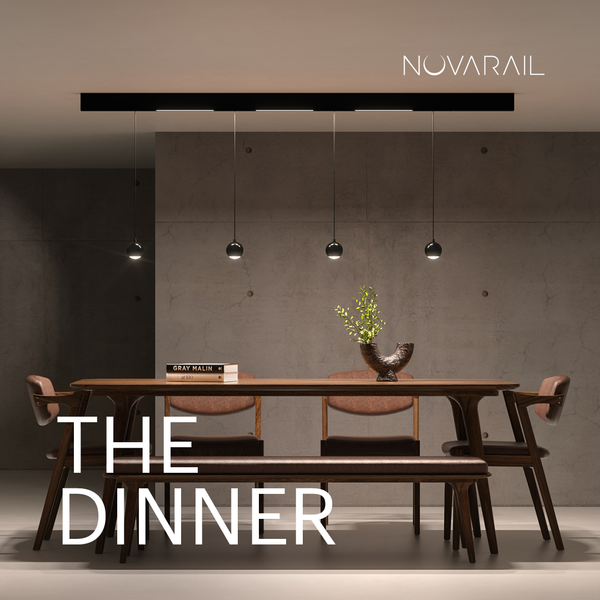
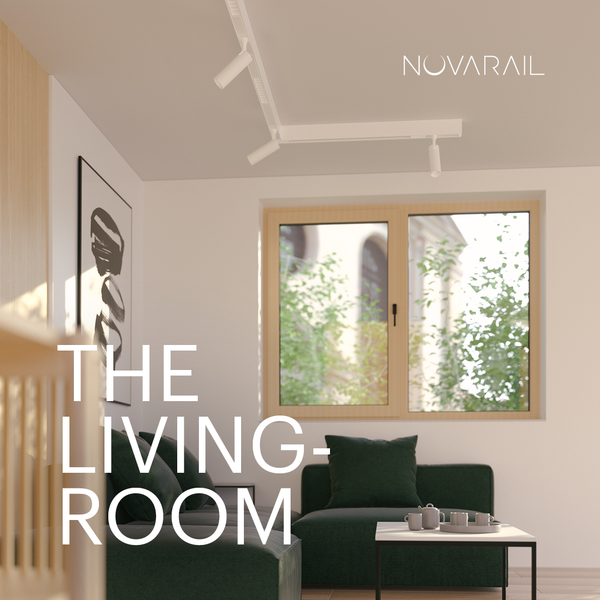
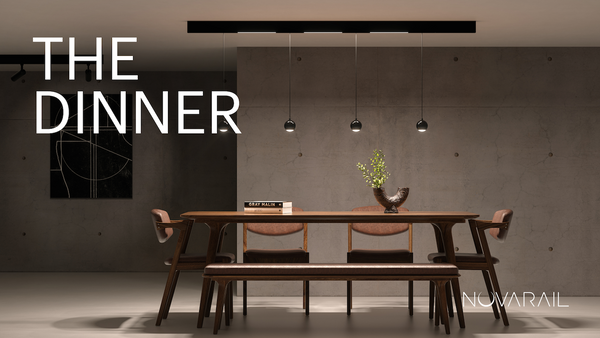
The more layers of light you combine, the more interesting and flexible your space will appear, both functionally and atmospherically. A typical NOVARAIL lighting composition could consist of a central ceiling light with adjustable color temperature – such as the White Stick – complemented by zone lighting over work surfaces or the dining table. The third layer is provided by mood lighting, realized through spotlights or indirectly integrated LEDs. This creates not only visual depth, but also a lighting landscape that can be specifically tailored to the time of day, use, and desired room atmosphere.
Intelligent Control – Smart Lighting Planning with a System
Modern lighting systems from NOVARAIL enable thoughtful, user-oriented lighting planning that goes far beyond classic control. With NOVARAIL, brightness and color temperature can be adjusted in real time, predefined scenes can be saved, for example for "Reading Mode," "Cooking Light," or "Relaxation," and even the natural biorhythm can be specifically supported. Thanks to interface compatibility with DALI, Zigbee, and Bluetooth, the system integrates seamlessly into existing smart home or building technologies.
Investing in Atmosphere: What Lighting Planning Costs
Professional lighting planning is more than a technical service – it is an investment in well-being, functionality, and design quality. Costs vary depending on project size, requirements, and desired scope of planning. For private living spaces, individual lighting planning usually starts in the range of 300 to 800 euros, including space analysis, a lighting zone concept, and recommendations for luminaires and control systems.
For larger projects, such as in commercial environments or architecturally demanding buildings, the effort and level of detail increase accordingly. Additional requirements often arise here, such as lighting compliant with DIN EN 12464-1, Human Centric Lighting, or the integration of intelligent control systems.
NOVARAIL offers the right solution for every starting situation: preconfigured lighting systems, which can be implemented quickly and efficiently, as well as custom-made plans in close cooperation with architects, interior designers, and specialist planners. This creates a holistic lighting concept: technically precise, thoughtfully designed, and cost-consciously calculable.
Conclusion: Lighting Planning That Connects People and Spaces – with Light That Thinks Along
Professional lighting planning requires more than just selecting lamps. It is about structuring the space functionally, staging it emotionally, and designing it to be technically future-proof. Those who use light consciously not only create better visibility – but also atmosphere, orientation, and quality of life.
Benefits of Thoughtful Lighting Planning and Human Centric Lighting
A professionally planned lighting concept is more than mere illumination – it is an integral component of interior design and fulfills functional as well as aesthetic tasks. Whether in a private living space or a commercial environment, the benefits are clear:
1. Functionality to the Point
Light exactly where it is needed – for concentrated work, relaxed reading, or atmospheric moments.
2. Atmosphere with Structure
The interplay of basic, zone, and accent lighting creates balanced, emotionally effective room lighting.
3. Save Energy with LEDs
Modern, dimmable LED luminaires reduce electricity consumption – sustainably and cost-efficiently.
4. Light as a Design Factor
High-quality luminaires specifically highlight materials, colors, and surfaces.
5. Compliant with Standards in the B2B Sector
Planning according to DIN EN 12464-1 ensures optimal lighting conditions at the workplace and fulfills statutory requirements.
6. Adaptable in Everyday Life
Light can be flexibly adjusted to the time of day, use, and mood – via an app or smart control.
7. Intelligent operation
Preset scenes, voice control or timers provide everyday convenience.
8. Future-proof and expandable
Modular systems grow with you – new luminaires or zones can be integrated at any time.
All these aspects result in a well-thought-out lighting system that not only enables, but also consistently implements Human Centric Lighting (HCL): a cohesive vision of excellent lighting quality, which puts people and their needs at the center.
Challenges for an optimal lighting concept
Despite the enormous potential of professional lighting advice and planning, certain requirements are also involved – requirements that, upon closer inspection, prove to be valuable opportunities for quality improvement:
-
a little more planning effort at the beginning, in exchange for a sustainable, tailor-made result
-
a higher initial investment, which pays off through efficiency, comfort and longevity
-
Smart lighting systems such as DALI, Zigbee or Bluetooth require suitable infrastructure – but offer maximum control freedom in return
-
basic technical understanding is helpful to use light in a targeted and error-free manner
-
lighting planning as part of interior design: function and design complement each other
With the NOVARAIL LED track system, this is achieved simply and stylishly. Modular, app-enabled and flexibly configurable, spaces can be illuminated individually.
Frequently Asked Questions
Can I expand my lighting later?
Yes, with NOVARAIL modular systems, additional light sources can be easily integrated, e.g. during redesign, room expansion or new requirements. Feel free to use our configurator for this purpose.
Does NOVARAIL offer preconfigured lighting solutions for commercial properties?
Yes, we offer preconfigured sets for offices, retail spaces, medical practices or restaurants – tailored to standards such as DIN EN 12464-1 (e.g. UGR < 19) and flexibly scalable.
Can I receive individual lighting planning?
Of course, our team can support you from the initial idea through lighting simulation to concrete product recommendations and configuration.
What is the lifespan of the LED lighting?
Depending on the type, our luminaires achieve up to 50,000 operating hours with consistent lighting quality.
Is NOVARAIL lighting also suitable for outdoor use?
Our lighting systems are designed primarily for indoor use – with a focus on high-quality, adaptable lighting for living spaces, offices, showrooms and architecturally sophisticated interior solutions. Currently, NOVARAIL offers no designated outdoor luminaires with the appropriate protection rating (e.g. IP44 or higher) for use in gardens, on facades or in areas exposed to the weather.
For applications in protected outdoor areas, such as covered balconies, loggias or entrance areas, individual luminaires may be suitable, provided that the environmental conditions are controlled. In any case, it is recommended to check the technical specifications of the respective luminaire or consult the planning or service team.
If you require outdoor lighting, a combination of NOVARAIL indoor lighting concepts and complementary weatherproof solutions from other manufacturers may be an ideal option. If you would like information or suitable recommendations on this, feel free to contact us, and we will of course take your requirements and application areas into account individually in the lighting plan. This creates a cohesive concept that impresses both indoors and outdoors.
Are the products eligible for subsidies (e.g. BAFA, KfW)?
Yes, many of our energy-efficient LED systems meet the requirements for commercial subsidy programs. Feel free to contact us.