Beam angle in LED spotlights: Beam shape & light distribution explained

In short: The beam angle describes how widely a luminaire distributes its light. A small angle concentrates the light, creating a narrow beam. A large angle distributes the light more widely and is better suited for area or general lighting.
What is the beam angle of LED spotlights?
The beam angle is given in degrees. It describes the angle of the beam emitted by a luminaire. For spotlights, it is particularly important because it determines whether the light appears focused, medium-wide, or broad.
As a rule of thumb: the smaller the beam angle, the more concentrated the beam. The larger the beam angle, the wider the light distribution.
Beam angle table: Which angle for which purpose?
| Beam angle | Lighting effect | Typical application |
|---|---|---|
| under 20° | very tightly focused | objects, art, accents |
| 20–30° | narrow spotlight | targeted accent lighting |
| 30–45° | medium-wide | kitchen, work surfaces, dining table, living areas |
| 45–60° | wide | more even zone lighting |
| over 60° | very wide / broad | general lighting, larger areas |
The classification is a practical guide. The actual lighting effect also depends on the optics, luminous flux, mounting height, and room geometry.
How do you calculate the beam diameter?
The approximate diameter of the beam can be calculated from the mounting distance and the beam angle:
Beam diameter = 2 × distance × tan(beam angle ÷ 2)
The distance is the distance between the luminaire and the illuminated surface.
Example at a distance of 2.5 m
| Beam angle | approximate beam diameter |
|---|---|
| 24° | approx. 1.06 m |
| 36° | approx. 1.62 m |
| 60° | approx. 2.89 m |
| 90° | approx. 5.00 m |
The calculation describes an idealized geometric beam. In practice, the brightness decreases towards the edges. For precise lighting planning, photometric data or lighting simulations are therefore more informative.
Which beam angle makes sense at a ceiling height of 2.5 m?
At a typical room height of about 2.5 m, medium angles often work well as a starting point. A narrow spotlight of about 20–30° sets targeted accents, while 30–60° covers larger areas.
However, when making a selection, room height should not be the only consideration. What matters is what is to be illuminated: a picture, a worktop, a dining table, or the entire room.
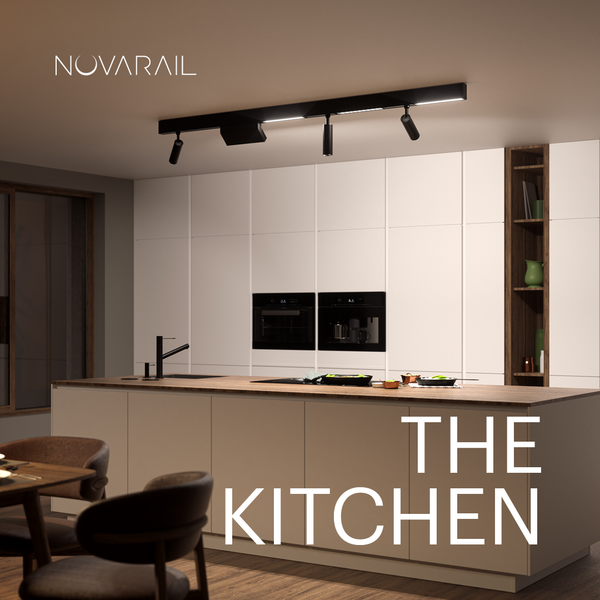
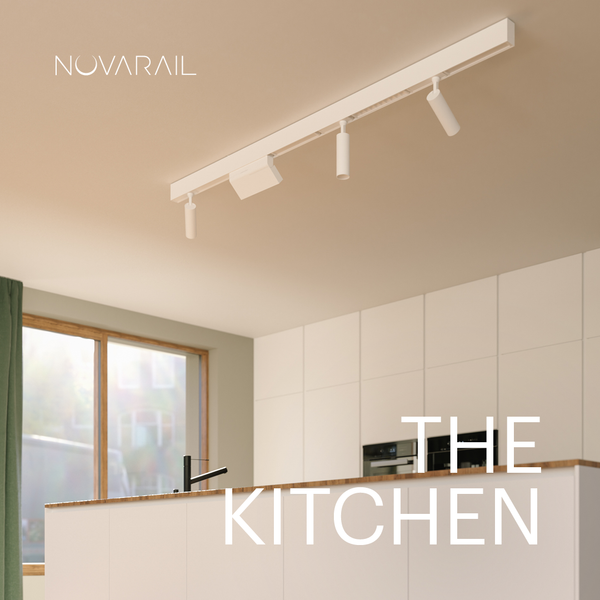
Which beam angle for the kitchen?
In the kitchen, different light distributions are often combined. Work surfaces benefit from targeted light, while wider beams are useful for general room lighting.
- Work surface: narrow to medium-wide
- Kitchen island: medium-wide or pendant light
- General lighting: wide
THE Kitchen – Track System for Worktop and Room Lighting
THE Kitchen X – Lighting for Kitchen Islands and Counters
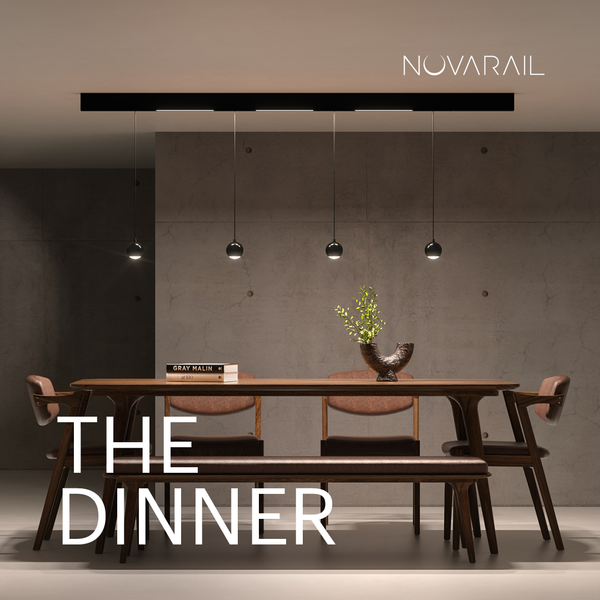
Which beam angle for the dining table?
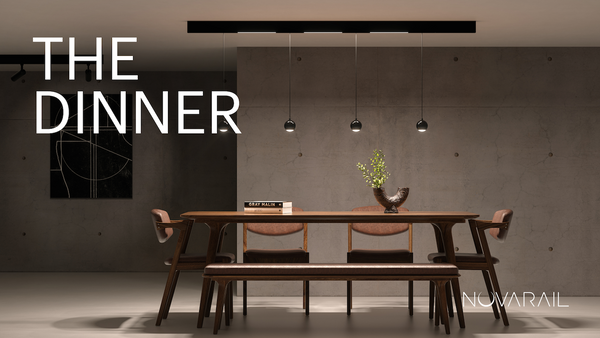
Above the dining table, the beam angle is not the only deciding factor. Pendant lights, mounting height, and table size strongly influence the lighting effect. The goal is usually to illuminate the tabletop clearly without unnecessarily over-illuminating the rest of the room.
With pendant lights, the combination of light distribution and luminaire height is therefore often more important than a single angle value.
THE Dinner – Pendant Lights and Room Lighting for the Dining Table
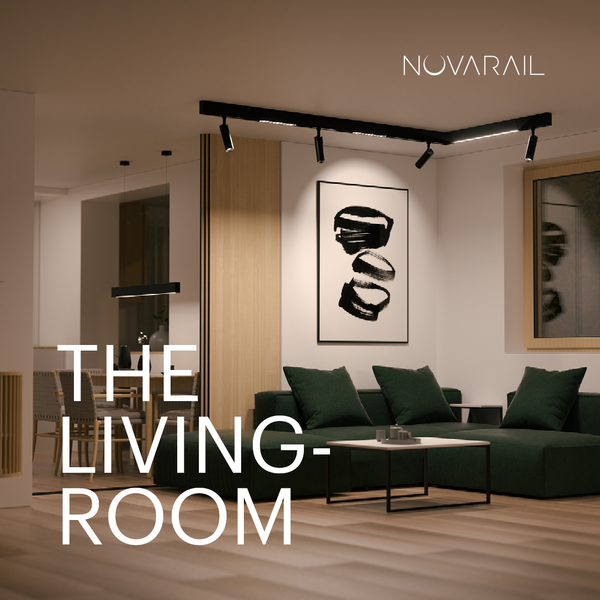
Which beam angle for the living room and accent lighting?
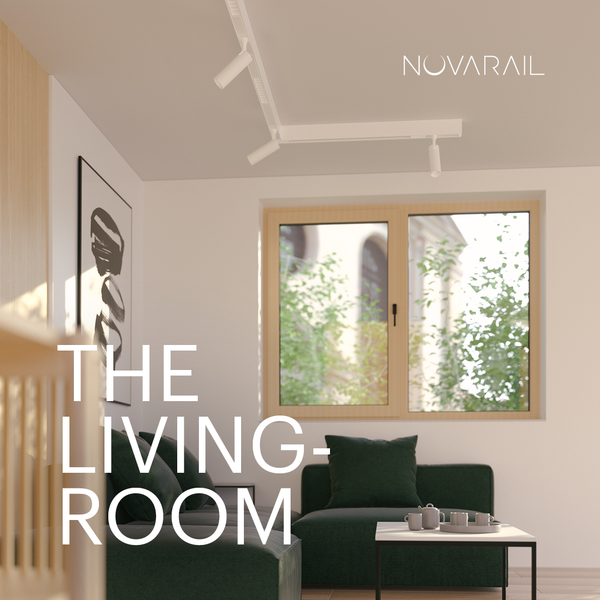
In the living room, several lighting zones make sense. A narrow spotlight can emphasize art, furniture, or architecture. Wider luminaires provide general lighting. This combination creates more depth than a single central ceiling light.
Which beam angle for the office and home office?
In the work area, uniform and glare-free lighting should be the priority. Very narrow spotlights can cause strong differences in brightness. For desks and general lighting, wider and more controlled light distributions are therefore usually more suitable.
Beam angle and lumens: What is the difference?
Lumens describe the total amount of light emitted by a luminaire. The beam angle describes how this amount of light is distributed in space.
Two spotlights can have the same luminous flux and yet appear completely different:
- narrow angle → higher light concentration on a small area
- wide angle → light is distributed over a larger area
Therefore, perceived brightness cannot be assessed based on lumens alone.
Beam angle and lux: Why does a narrow spotlight appear brighter?
A narrow spotlight distributes its luminous flux over a smaller area. As a result, the illuminance in lux can be higher in the center than with a luminaire with the same luminous flux and a wider angle.
This does not automatically mean that the narrower spotlight produces “more light” – it simply concentrates it more.
How far apart should LED spotlights be placed?
There is no universal distance. The correct distance depends on the beam angle, mounting height, luminous flux, and desired uniformity.
For uniform general lighting, the beams should usually overlap partially. For accent lighting, however, a deliberate distance can be left between the beams.
Anyone planning multiple spotlights should therefore not only measure the distance between the luminaires but also consider the beam on the target height.
What is a luminous intensity distribution curve (LDC)?
A luminous intensity distribution curve shows how strongly a luminaire emits light in different directions. It is often displayed as a polar diagram.
An LDC is more precise than simply stating a beam angle because it shows how the light intensity actually changes inside and outside the main beam.
For professional lighting planning, architecture, and larger projects, such photometric data are particularly helpful.
Direct, indirect, and diffuse light
Direct light
Direct light hits the target surface without significant reflection. It is suitable for work areas, accents, and targeted lighting.
Indirect light
Indirect light is first reflected off the wall or ceiling. This makes it appear softer and creates less harsh shadows.
Diffuse light
Diffuse light is distributed widely by a diffusing optic or cover. It is well suited for uniform general lighting.
Plan the beam angle in the 3D configurator
A good lighting concept combines different types of light. In a modular track system, spotlights, pendant lights, and wide-beam modules can be positioned where they are actually needed.
Plan the NOVARAIL lighting system in the 3D configurator
Frequently asked questions about beam angles
What does a 24° beam angle mean?
24° is a relatively narrow beam angle. At a distance of 2.5 m, this results geometrically in a beam with a diameter of approximately 1.06 m.
What does a 36° beam angle mean?
36° is a medium-wide spotlight angle. At a distance of 2.5 m, this results in a beam with a diameter of approximately 1.62 m.
What does a 60° beam angle mean?
60° distributes the light significantly more widely. At a distance of 2.5 m, this results geometrically in a beam with a diameter of approximately 2.89 m.
Is a small beam angle brighter?
With the same luminous flux, a small beam angle usually appears brighter in the center because the light is concentrated on a smaller area.
Which beam angle is suitable for pictures?
Narrower angles are often used for accent lighting. The appropriate value depends on the picture size, distance, and desired beam.
Which beam angle is suitable for general lighting?
Wider light distributions are usually used for general lighting so that larger areas are illuminated evenly.
Can I calculate the beam diameter?
Yes. Approximately: Beam diameter = 2 × distance × tan(beam angle ÷ 2).
Further reading: Understanding the 48-V LED track system
How the track, transformer, spotlights, pendant lights, and room lights work together at NOVARAIL is explained in our central system guide: 48-V LED Track System – Design, Advantages, and Applications.
Conclusion
The beam angle determines whether an LED illuminates a point or an area. Under 30° is better suited for accents, about 30–60° for many zone and work applications, and larger angles for broad general lighting.
For a good result, the beam angle, luminous flux, mounting height, color temperature, CRI, and room geometry should always be considered together.